


 REQUEST A CATALOG
 REQUEST A QUOTE
Thermoforming is a versatile process that heats a plastic sheet until it becomes soft, then forms it over or into a mold. It is frequently the most practical method for producing large or moderately complex three-dimensional plastic parts in low-to-medium volumes. Tooling is typically far less expensive than injection molding, and lead times are shorter than hard-tool programs.
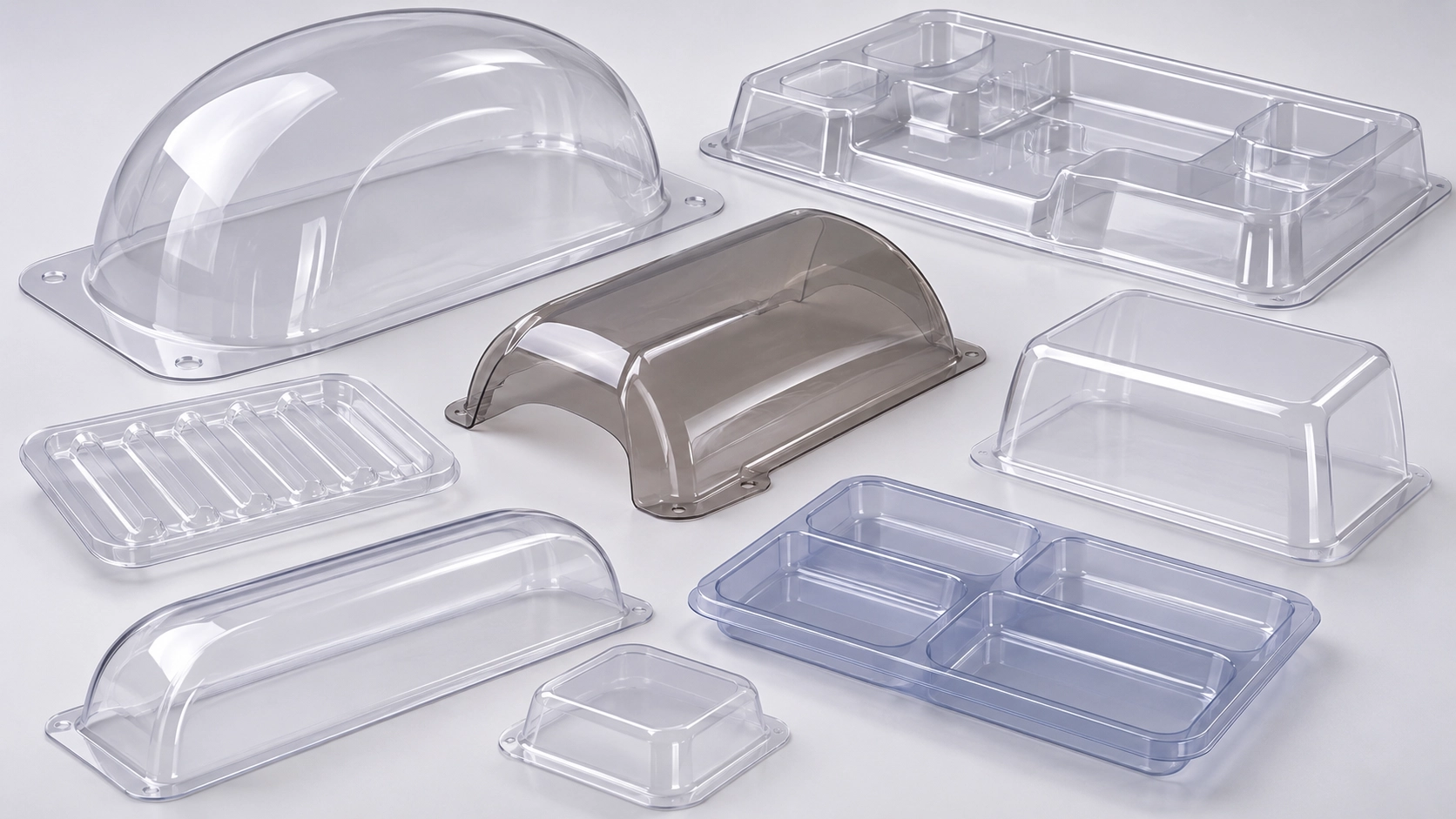
ACI Plastics provides thermoforming (vacuum, pressure, and drape) along with complementary laser cutting, CNC routing, material supply, and design support. This combination is particularly useful for retail fixtures, covers, trays, housings, and custom components that combine formed and flat elements.
Main Thermoforming Methods
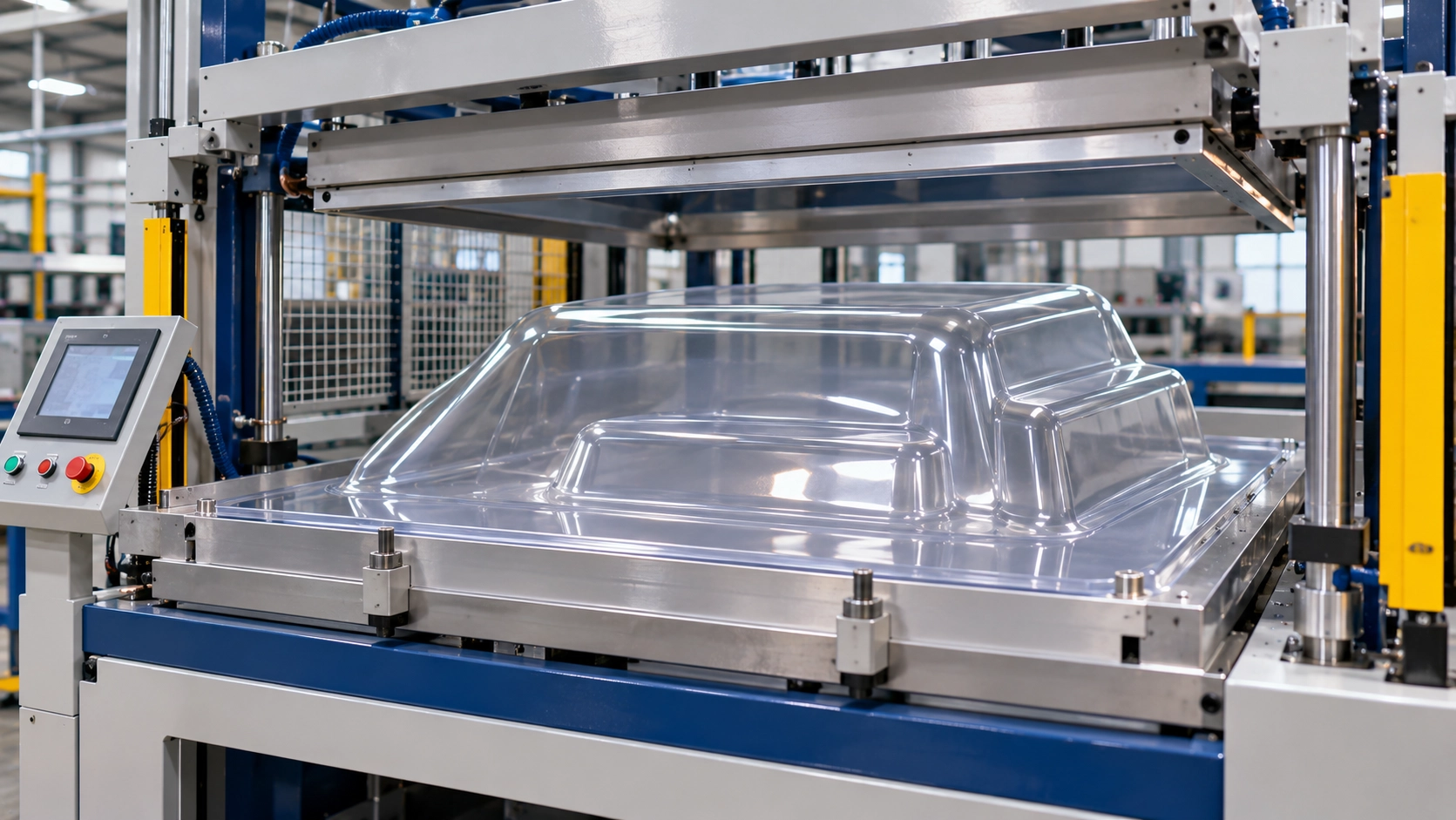
- Vacuum forming — A heated sheet is drawn onto a mold using vacuum. It is widely used for trays, covers, and display components where moderate detail is sufficient.
- Pressure forming — Adds positive air pressure to push the sheet more firmly against the mold. This produces sharper detail and better surface finish than vacuum forming alone.
- Drape forming — The heated sheet is draped over a mold, useful for certain large or simple curved shapes.
When Thermoforming Is the Right Choice
Thermoforming makes sense when:
- The part is relatively large or has organic/curved geometry.
- Annual volume is too low to justify injection-mold tooling but high enough that pure CNC machining becomes expensive.
- You need faster tooling and shorter lead times than traditional molding.
- Suitable sheet materials (ABS, HIPS, PETG, acrylic, polycarbonate, and others) meet the performance requirements.
Advantages and Limitations
Thermoforming offers lower tooling cost than injection molding, good suitability for large parts, and relatively fast turnaround for both prototypes and production. Wall thickness is not perfectly uniform, and very fine details or undercuts are more limited than with molding or full multi-axis machining. Secondary trimming is normally required after forming; this is often completed on a CNC router.
How It Fits with Other Fabrication Methods
Many successful projects combine thermoforming with laser cutting or CNC routing. Formed covers or trays can be paired with laser-cut acrylic panels or routed structural elements. ACI’s in-house capabilities make this integrated approach straightforward.
Frequently Asked Questions (FAQ)
Is thermoforming cheaper than injection molding?
For lower volumes, yes. Tooling cost is usually significantly lower, which reduces the break-even quantity.
What materials work well for thermoforming?
Common options include ABS, high-impact styrene (HIPS), PETG, acrylic, and polycarbonate. Material choice depends on clarity, impact, temperature, and chemical requirements.
Can you prototype with thermoforming?
Yes. Tooling can often be produced relatively quickly, making it practical for design validation and short runs.
Does thermoforming require secondary operations?
Most parts need trimming after forming. CNC routing is commonly used for this step and can also add holes, slots, or other features.
Have a part that might be a good candidate for thermoforming? Contact ACI Plastics for design feedback, material recommendations, and a quote. We support projects from prototype through production with U.S.-based facilities and fast turnaround.


